
Reviewed · SELF-GUIDED TOURS
Love and War in Berlin: Self-Guided Story Puzzle Walk
Berlin gets most of its attention for big monuments and famous museums, but this kind of self-guided story puzzle walk gives you a different angle. You’re moving through real, lived-in corners of Mitte, solving clue questions on site, and building a clearer picture of WWII-era history as you go.
I like the flexible timing. You can start at your own pace, pause for breaks, and then jump back in without feeling rushed. I also like the price and format, because for $6 per person you get a full hour-ish route with an offline game and no need to coordinate with a person holding a clipboard.
One thing to consider is that puzzle walks need a bit of attention. If you prefer a hands-free, purely scenic stroll, you might find yourself stopping frequently to scan details and think through answers before you can continue.
What makes this Berlin puzzle walk worth your time
- Offline game play, so you are not dependent on cell service to keep going
- Private setup with no human contact, which helps you avoid crowd pressure
- One-hour pace that works well for tight itineraries or a low-commitment history add-on
- WWII-focused sights in Mitte, from major memorial space to darker learning stops
- Every stop is interactive, you look around locally to advance to the next chapter
- Designed for English, so you can stay in-language throughout
How this self-guided format helps you see Berlin at human speed
This is not a sit-and-listen tour. It’s an on-the-ground story game, built around short stops where you hunt for a detail, answer a prompt, and then move on. That sounds simple, and it is, but the payoff is real: you’re forced to slow down enough to notice what Berlin looks like in layers.
You’ll also appreciate the structure when you’re traveling. The route is set up so you can start whenever you want within the daily window, take a break whenever you like, and resume later. That matters in Berlin because plans change fast, even when the city feels calm.
Then there’s the practical side. The game runs offline, and you get a mobile ticket. In other words, you’re not juggling logins, searching websites, or hoping your map app behaves. This is one of those experiences where the “tech” stays out of your way.
More walking tours in Berlin:
- Discover Berlin Half-Day Walking Tour
★ 5.0 · 9,624 reviews - Berlin: Third Reich and Cold War 2 Hour Walking Tour
★ 4.9 · 6,830 reviews - Berlin: Discover Berlin Walking Tour
★ 4.9 · 5,998 reviews
Starting at Alexanderplatz, the Urania World Clock clue hunt
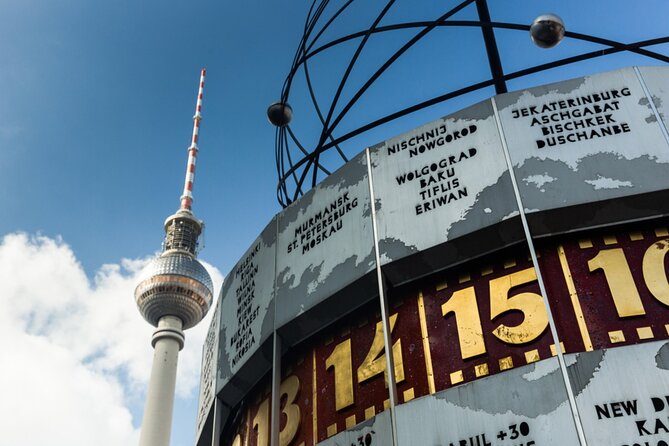
Your walk begins at Alexanderplatz, at Alexanderpl. 1, 10178 Berlin. The first stop uses the Urania World Clock in the square, the turret-style clock you’ll see marked for cities across the world.
Here’s the interesting trick: the challenge asks you to look around and find the information needed to advance. This is a smart way to start because it does two things at once. First, you get your bearings in a major hub. Second, you practice the puzzle style early, before the history gets heavier.
Also, Alexanderplatz is not some quiet museum corner. It’s a real transport-and-shopping center, so it’s a good place to orient yourself without feeling like you’re walking into a staged setting.
If you’re sensitive to crowds, pick a start time a bit earlier in the day. Alexanderplatz can be lively, even when you’re not trying to be.
Berlin Rathaus architecture, where style becomes political language
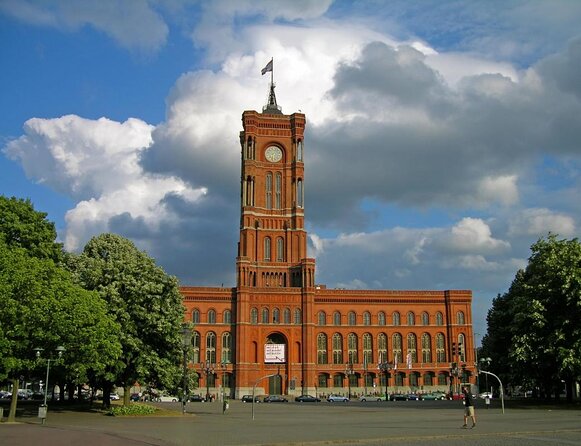
Next comes the Rathaus, built from 1861 to 1869 by Hermann Friedrich Waesemann. The building is in a Northern Italy High Renaissance style, and it was modeled on the Old Town Hall of Thorn (today Toruń, Poland). The tower’s look is also said to echo a cathedral tower in France, Notre-Dame de Laon.
This is one of the most useful types of history stops in Berlin: not just what happened, but how the city wanted to look while it was happening. When you’re solving the Rathaus challenge, you’re training yourself to notice the building as a document. Details like proportions, tower silhouette, and historical styling choices tell you a lot about what was valued when this city was building its public image.
One drawback: if you’re rushing, it’s easy to walk past without absorbing much. The puzzle nudges you to slow down. Take the extra minute, or you’ll miss the point of this stop.
Neptunbrunnen (Neptune Fountain) in 1891, a myth used in public space
At Neptunbrunnen, you’re looking at the Neptune Fountain, built in 1891 and designed by Reinhold Begas. The Roman god Neptune sits at the center, which is a classic European move: myth becomes decoration, and decoration becomes civic identity.
The reason this stop works inside a WWII-themed puzzle route is context. Berlin didn’t only become tragic because of war. It was a modernizing, civic-minded capital with public art, grand squares, and symbolic storytelling long before the 1930s.
You’ll find a free 10-minute stop time here, and it’s ideal for a quick reset. If you need a breather from thinking, this is a good place to grab water nearby and then re-focus on the next challenge.
More self-guided tours in Berlin:
- Berlin: Solar Powered Sunset Catamaran Cruise & Audio Guide
★ 4.6 · 1,043 reviews - Berlin: Panoramic Boat Tour with Bilingual Audio Guide
★ 4.1 · 136 reviews - Berlin: Self-Guided Family and School Class Scavenger Hunt
★ 4.6 · 128 reviews - Berlin: Scavenger Hunt Self-Guided Tour
★ 4.6 · 79 reviews
Marx-Engels-Forum, 1986 memory in the middle of the city
The route then heads to Marx-Engels-Forum, a public park in Mitte named for Karl Marx and Friedrich Engels, authors of the Communist Manifesto of 1848. The park was created by authorities of the former GDR in 1986.
This stop is valuable if you want WWII history in a larger frame, because Berlin’s 20th century did not stop in 1945. The city kept rewriting meaning, building new landmarks, and choosing what kind of political story to tell in public.
In puzzle form, you’ll still be doing the same look-around behavior. That helps you treat the forum as more than scenery. You’re encouraged to connect who is being honored, when it was built, and why that matters for how Berlin remembers.
A practical tip: park areas can be windier than you expect. If you’re doing this during cooler months, dress for it.
Lustgarten, where power stages were built on parade ground
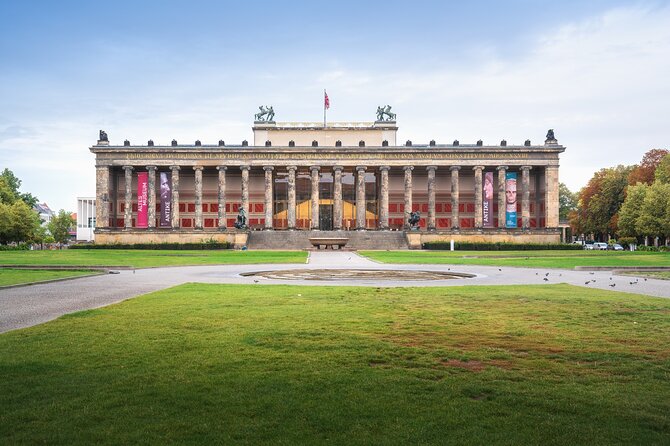
Next is Lustgarten, on Museum Island near the former Berliner Stadtschloss, the Berlin City Palace. Over time, this park has served as a parade ground, a place for mass rallies, and a public garden.
This stop is a strong reminder that many of Berlin’s “open spaces” were never neutral. Even when the lawns look peaceful, the ground has been used for large-scale political theater. The puzzle challenge makes you work with that idea. You are not just learning facts, you’re being asked to connect place with purpose.
If you love Museum Island and its edges, this is the kind of stop that turns a background landmark into part of your story. It also sets you up emotionally for later memorial sites, because you’ll see how public space has been used for both celebration and control.
Neue Wache and Prussian neoclassical memorial architecture
At Neue Wache on Unter den Linden, you’re stepping into a major work of Prussian Neoclassical architecture. The building was erected from 1816 to 1818 by Karl Friedrich Schinkel, first as a guardhouse for the Royal Palace and later as a memorial to the Liberation Wars.
This stop works well in a puzzle walk because it gives you a chance to slow down and think about meaning. A memorial building is not only about what it commemorates, it’s also about how a style of architecture tries to shape emotion. In other words, you’re looking at design choices made to carry memory.
The challenge here asks you to look around and find what you need to move forward, so take a few minutes. Don’t treat it like a quick photo stop.
Also note, the corridor feel of Unter den Linden can be long. If you’re prone to walking fatigue, plan short pauses. The self-guided nature is meant for that.
Bebelplatz, the 1933 Nazi book burning site
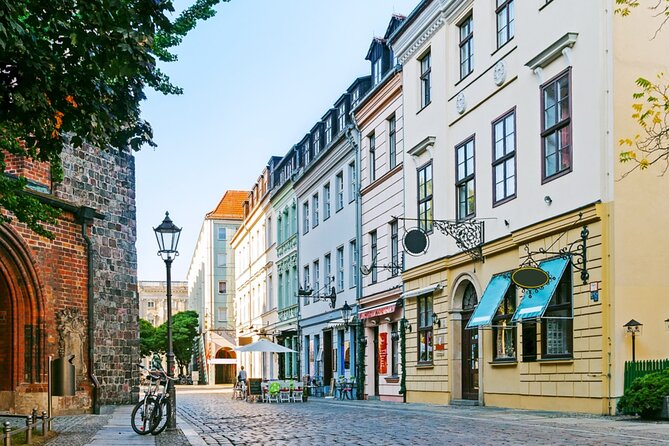
Then you reach Bebelplatz, widely known as a site of the Nazi book burning ceremony on the evening of 10 May 1933. The book burnings were initiated and hosted by the nationalist German Student Association, taking an early lead over the later National Socialist German Students’ League.
This is one of the hardest stops on the route, and that’s not a complaint. It’s important that the puzzle does not keep the history abstract. It points you at a specific event and forces you to connect ideology with action.
The stop is listed for about 10 minutes, and the practical advice is to give it the full time. This isn’t a place to skim.
Also, this site tends to feel quiet and reflective around it, even on busy days. If you’re photographing, step back and let yourself actually read and absorb before moving on.
Gendarmenmarkt, church towers, and the Konzerthaus link
At Gendarmenmarkt, you’ll learn that the square gets its name from the Gens d’armes cuirassier regiment, whose stables were demolished by Friedrich II. Between the two churches, a theater was built that is now the Konzerthaus Berlin.
What I like about this stop is the contrast. After darker history, you get a return to grand urban beauty, but it’s not empty prettiness. The puzzle approach keeps it grounded, because you’re looking for answers that tie the square’s identity to its past.
And since the stop is listed for about 10 minutes with free admission, it’s perfect as a mental palate cleanser. Not because the history is forgotten, but because Berlin’s story includes both tragedy and civic pride, often in the same walking day.
If you get cold or tired, this square is also the kind of place where it’s easy to take a short sit-down break nearby.
Hamburg’s state representation in Berlin, politics as everyday life
Next is a quieter-feeling but fascinating stop: the state representation of the Free and Hanseatic City of Hamburg in Berlin, at Jägerstraße in the government district. Over 500 events and encounters take place each year in that classicist town house, and it’s described as where Hamburg makes politics in the capital and participates in federal legislation through the Federal Council.
This part of the route is a reminder that postwar Germany is not only memorial and museums. It’s also institutions, meetings, and real governance happening day after day.
In puzzle terms, you’ll again look around for what you need to advance. But the bigger benefit is mental. You’re not only learning WWII. You’re seeing how Berlin functions now, and how that function sits next to past trauma.
Memorial to the Murdered Jews of Europe, a place where the game gets serious
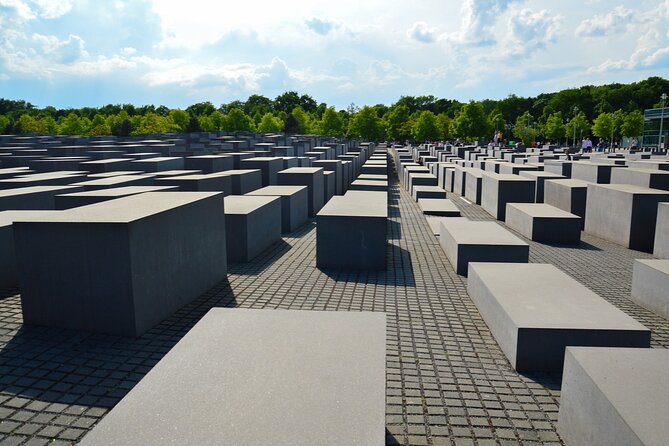
Finally, the route brings you to the Memorial to the Murdered Jews of Europe. In 1999 the German parliament decided to establish a central memorial site, and the design competition was won by New York architect Peter Eisenman. It was ceremonially opened in 2005.
The puzzle at this point is not just about moving forward, it’s about meeting a site with weight. This memorial is one of Berlin’s key places for remembrance, and the fact that the game still asks you to look closely makes sense. It nudges you toward slower, more careful attention.
This is where I’d be especially cautious about timing. If you’re running out of daylight, keep the pace steady. Don’t let the puzzle stress you out. You can take the breaks that the format allows, and you’ll still finish within the approximate hour.
The route ends at Cora-Berliner-Straße 1, 10117 Berlin. Plan your next stop with that in mind, because you’ll want an easy route to your onward transport.
Value for money: why $6 can still feel like a real experience
At $6.00 per person, this is priced like a quick add-on, but it doesn’t feel disposable because you’re buying a full activity block, not just entrance tickets. You get a private, self-guided format with offline support, and you’re covering a cluster of high-impact sites in central Berlin.
If you split costs with a partner or small group, the value can get even better, especially because the experience notes group discounts. For a solo traveler, it’s also a good deal when you want structure without paying for a guide.
It’s not a museum pass. There are free admission notes for some stops, like Neptunbrunnen, Bebelplatz, and Gendarmenmarkt. But the real value here is the guided logic, the way the route uses the city’s physical details to teach history as you walk.
Who should book this story puzzle walk
You should strongly consider it if you want:
- A low-pressure, self-paced way to see central Berlin
- WWII-era learning that connects sites with context
- An activity that fits in about one hour
- A route you can do without worrying about internet or coordinating with anyone
You might skip it if you:
- Hate puzzle-style tasks and would rather have a straight guided explanation
- Want a purely scenic walk with minimal stopping
- Need a highly structured, instructor-led experience the whole time
One more situational thought. If your timing overlaps a busy seasonal market, you might find yourself making small route maneuvers to stay on track. The good news is that the self-guided nature is built for flexible walking, not strict group marching.
Should you book Love and War in Berlin in Mitte?
Yes, if you want a smart way to spend an hour in one of Berlin’s most important neighborhoods. This route hits major checkpoints for understanding Germany’s 20th century, and it does it in a way that makes you pay attention, not just stand and read a plaque.
Book it if you’re traveling light, value privacy, and prefer learning through observation. It’s also a solid option for people who have done some Berlin museums already and want something that feels more like walking through a story than checking boxes.
FAQ
FAQ
How much does Love and War in Berlin cost?
The price is $6.00 per person.
How long does the self-guided puzzle walk take?
It’s listed as about 1 hour (approx.).
Do I need an internet connection to play?
No. The experience is designed so you can play offline and you do not need an internet connection.
Is this experience private?
Yes. It’s a private tour or activity, and only your group will participate.
Where do I start and where does it end?
You start at Alexanderpl. 1, 10178 Berlin, Germany and end at Cora-Berliner-Straße 1, 10117 Berlin, Germany.
Is it offered in English?
Yes, it is offered in English.
Recently added around Berlin
- Ultimate E-Bike Tour of Berlin with Beer Garden Stop★ 5.0 · 4 reviews
- Berlin: guided canoe | kayaktour★ 4.1 · 7 reviews
- Where It All Began: Berlin’s Queer & Trans History Tour★ 4.9 · 6 reviews
- Understanding Kreuzberg: The roots of local (sub)culture★ 4.9 · 11 reviews
- Warnemuende Shore Excursion: Private Berlin Tour★ 4.5 · 27 reviews
- Your ticket to The Wall Museum Berlin★ 3.0 · 60 reviews
- eSIM for Germany and 34 European Countries★ 4.5 · 16 reviews
- Walking on the Wall: 3-Hour Tour in Berlin★ 4.5 · 34 reviews
Self-Guided Tours, compared.
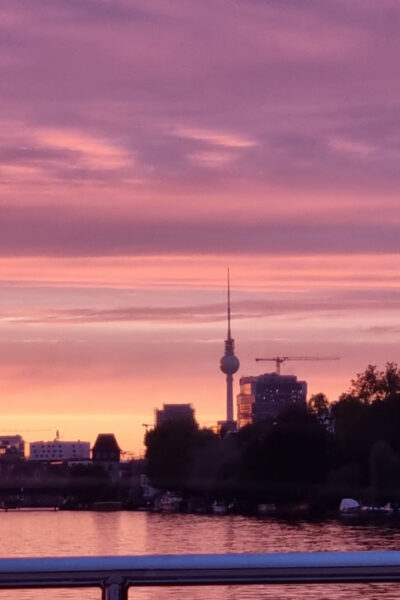
Solar Powered Sunset Catamaran Cruise & Audio Guide
Read our review →
Self-Guided Family and School Class Scavenger Hunt
Read our review →
Französischer Dom Viewing Platform with Audio Guide
Read our review →
Berlin Wall: Greatest Escapes Self-Guided Walking Adventure
Read our review →
Berlin Kreuzberg: Scavenger Hunt Self-Guided Tour
Read our review →
Berlin Prenzlauer Berg: Scavenger Hunt Self-Guided Tour
Read our review →Browse the lists this tour appears in