
Reviewed · TRABI SAFARIS
Berlin Self-Drive Trabi Tour with Guide
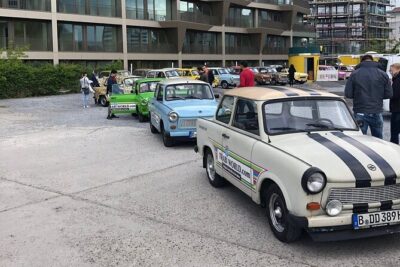
Driving a Trabant through Berlin sounds like a gimmick until you do it. The small car, the convoy feel, and the stop-and-go city pace make this one of those tours that teaches you where things are fast, without the walking burn. Guides like Thomas are calm and safety first, and the whole vibe turns you into part of the show as other people snap photos.
I love two things most. First, you get a proper road briefing before you go, including how to handle the manual gearbox. Second, you cover Berlin’s iconic center in a short time, with built-in photo and story stops that make the city make sense. One drawback: if you are not comfortable with a stick shift, you may feel stressed, and the car experience includes a lot of noise, vibration, and cobblestone bumping.
Key things to know before you go
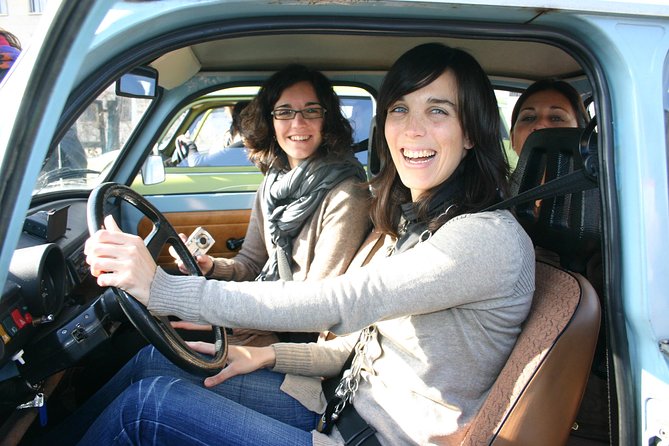
- You drive a classic East German car (standard gearbox is the norm, automatic only after prior consultation)
- You ride in a guided convoy so you see big sights without worrying about routing
- Short city loop, big “where am I” payoff from central squares to Wall sites
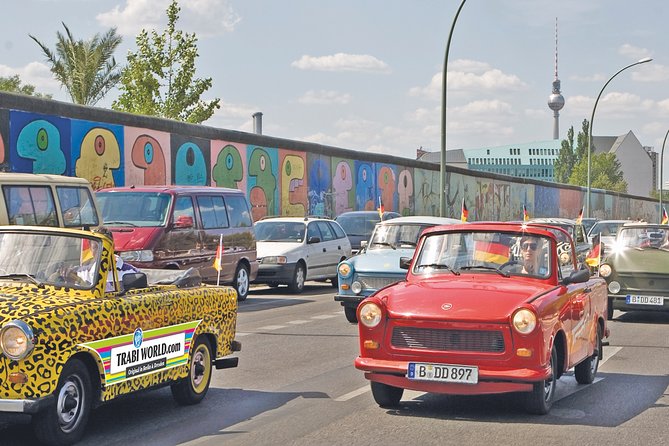
- East Side Gallery is a major highlight with murals on a 1,316 m stretch of preserved Wall section
- Radio instructions are one-way so you listen for directions, but you cannot talk back
- Arrive early for a smooth start because the briefing and lineup matter
Why a Trabi convoy is such a smart way to learn Berlin
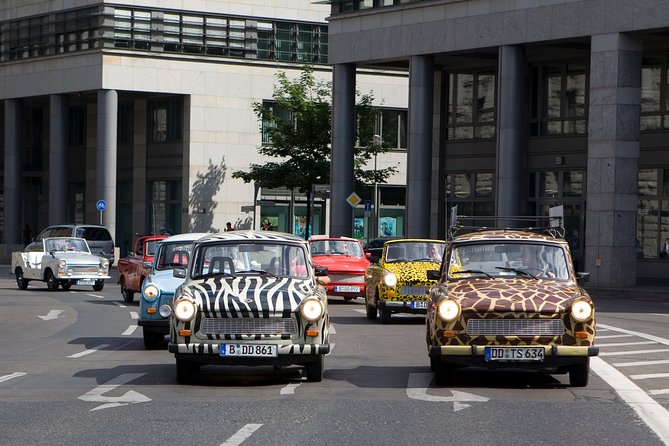
Berlin is huge, and most first-time plans end up as a blur of walking, transit confusion, and “wait, where are we?” This tour tackles that head-on. You drive in a tight group, follow an experienced guide, and get enough context to connect neighborhoods and landmarks to each other.
The best part is how quickly your brain maps the city. One moment you are near Potsdamer Platz, then you are passing the grand civic and boulevard areas, then you end up at Wall-era sites like the East Side Gallery. It is a fast route, but it is not random. The guide keeps it moving while still explaining what you are seeing, so you leave with a clearer mental picture than you would from hopping off public transit between stops.
Also, you should know this is a sensory experience. Old cars shake. Traffic sounds louder. Engine noise can make commentary harder to hear sometimes, especially on radio. That can be a downside if you hate noise, but if you enjoy the physical reality of a machine, it becomes part of the fun.
And yes, people notice you. The convoy setup means you are rolling through central streets in one of Berlin’s most recognizable icons. Expect pedestrians and drivers to look, and expect plenty of photo moments.
More Trabi drives in Berlin:
- Berlin: 75-minute Trabi Safari
★ 4.8 · 2,854 reviews - Private Tour: Berlin by Trabant Stretch-Limousine
★ 5.0 · 186 reviews - Berlin: The Wall Ride Guided Trabi Tour
★ 4.7 · 157 reviews
Getting ready at TrabiWorld Berlin: briefing, gear, and what to bring
You start at TrabiWorld Berlin, Zimmerstraße 97-100, 10117 Berlin. The welcome and briefing is about 10 minutes, then you get going from there. The tour is offered in English, and it uses a mobile ticket, which keeps it simple.
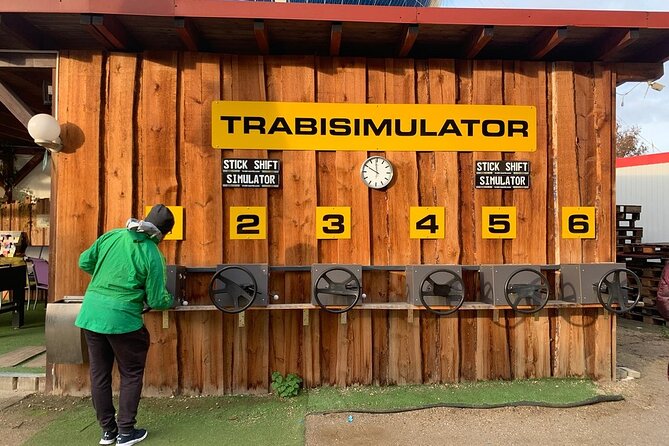
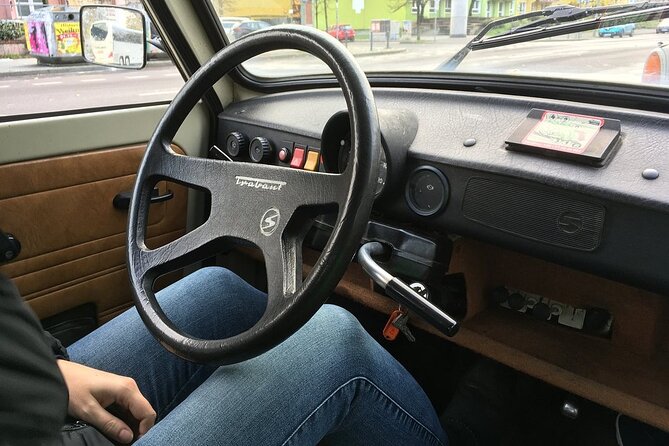
Before you drive, you get orientation on operating the manual gearbox and the four-stroke engine. This matters because the fun depends on feeling in control. If you already drive stick shift, you will likely settle in quickly. If you do not, do not treat this as a casual “press start” activity. Give yourself a few minutes to absorb the instructions and take it slow until you feel comfortable.
What you should bring:
- Your driver’s license, with evidence required for non-automatic cars (so if you do not have the right license, confirm ahead of time)
- Comfortable, closed-toe shoes for cobblestone streets and frequent stopping
- Water or a light snack. Food and drinks are not included
A few practical tips from the way this runs in the real world:
- The tour has a maximum of 12 travelers, and the maximum people per vehicle is 4, so you are not stuck in a giant crowd. Still, arrive early so you can find the right car and get sorted without rushing.
- Radio guidance is used, and you can hear the guide, but you cannot talk back. If the engine noise is loud, plan to listen closely during key turns and convoy regrouping.
- There is a shop and bathrooms at the starting area, which helps if you want to handle basics before you start driving.
The core route you will drive: Potsdamer Platz to the Brandenburg Gate area
This is a central Berlin loop, and the stops you pass through are chosen because they anchor the city’s story. The exact turns can vary a bit based on street conditions, but the lineup is built around classic landmarks.
You start with Potsdamer Platz, the busy heart where Berlin’s post-war and modern identities collide. Even if you know the photos, driving through the streets gives you the scale. After that, the route reaches toward Brandenburg Gate, the famous 18th-century neoclassical monument that is basically a symbol at this point. In the Trabi, it hits differently, because you are not photographing it from far away. You feel the street approach and the energy of the area.
Next comes a grand boulevard stretch, a key corridor that links major civic zones. In Berlin, those long boulevards are where you understand how the city was designed to move people and power. You are not just seeing buildings, you are seeing the layout.
What makes this segment valuable is that it gives you orientation. By the time you reach the more memorial and Wall-related stops later, you know how everything fits together. You also get that convoy rhythm, so you do not have to stop to consult maps or keep checking which train station is next.
One thing to keep in mind: the drive includes cobblestones and city traffic, so you will feel the car. The “terrible but lovable” reputation is part of it. If your goal is smooth, silent sightseeing, you might find the ride tiring. If your goal is to experience Berlin at street level, this is a strong match.
Unter den Linden, Berlin Cathedral area, and the idea of civic Berlin
As the route moves from squares and monuments toward boulevard spaces, you start to see the civic side of Berlin. The grand boulevard segment connects you to the areas you might recognize from photos and guidebooks, including the Unter den Linden-style corridors and landmark zones near the Berlin Cathedral.
This part of the drive is about context. You will often pass by big, official-feeling buildings and learn how Berlin’s center developed around institutions and state power. The guide typically explains what you are seeing as you bump along, which is where this tour becomes more than a photo stop.
You may also pass key viewpoints like the Berlin TV Tower area. Even if you do not leave the car to go up, seeing it from the street route helps. Berlin’s TV tower is a visual anchor. When you know its place relative to everything else, your later visits to museums, markets, and the riverwalks become easier.
A quick note on hearing the commentary: the Trabi is loud and vibrates. On some rides, the static or engine noise can make it harder to catch every word. That does not mean the guide’s information is weak. It means you should accept that you are doing a driving experience first, listening experience second. If you want maximum storytelling clarity, sit where your radio reception is best and focus during turns.
A few more Berlin options worth a look
- Berlin: Reichstag, Dome and Government District Guided Tour
★ 4.7 · 18,288 reviews - Berlin: Government District around the Reichstag Guided Tour
★ 4.7 · 8,447 reviews - Berlin: Hidden Backyards Guided Walking Tour
★ 4.8 · 5,360 reviews - Berlin: 1-Hour Boat Tour with Bilingual Live Guide
★ 4.7 · 3,629 reviews
East Side Gallery: murals, Wall remnants, and why it lands as a drive-by
The most famous stop on your loop is the East Side Gallery, with murals painted directly on a preserved remnant of the Berlin Wall. This stretch is 1,316 m (4,318 ft) long, and it is open-air. Even a short stop here can make the Cold War feel immediate, because you are seeing art built into the physical barrier itself.
This is one of those places where walking is usually the default. On this tour, you see it as part of the flow of the city. That is actually helpful. The guide’s commentary ties it back to earlier parts of your route, so the story does not stay stuck in one museum-like box. You connect Wall-era moments to the civic center you already drove through.
The tour also includes another Wall-era touchpoint, a former border cross point area later in the route, which rounds out the sense of how Berlin used to be divided. Together, these stops help you understand why East Berlin landmarks are so tied to memory and identity.
Practical things to plan for at East Side Gallery:
- You will likely have only a short window compared with a dedicated walking tour
- Bring a phone camera or small camera, but also take a few seconds to just look. The length of the wall section matters
If you care about modern history in a visual way, this is where the tour becomes memorable beyond the driving.
Oberbaum Bridge, Rotes Rathaus, and the river rhythm

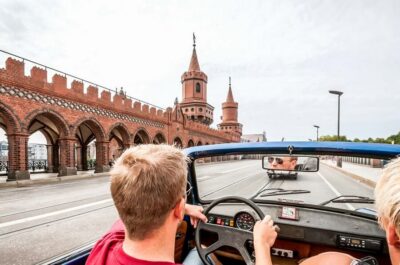
Between the Wall landmarks and the next iconic checkpoint stop, the route passes through areas that show Berlin’s built environment and river character. One highlight is the Oberbaum Bridge, the double-deck bridge crossing the River Spree. Driving over or through the surrounding streets gives you a sense of how the river shapes movement in the city.
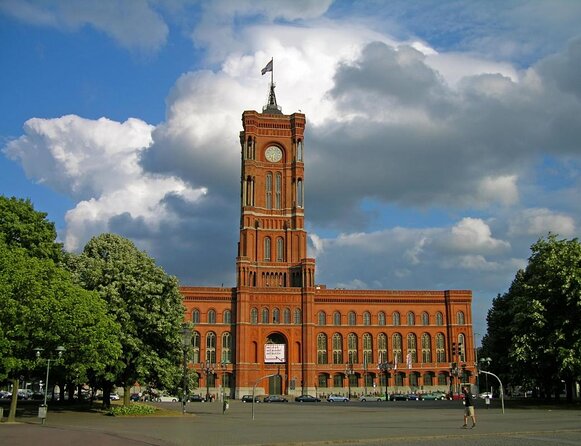
Then you reach the Rotes Rathaus, the red town hall dating from 1870. This is one of those Berlin landmarks that feels like it belongs in a historic film. From the Trabi, it looks even more theatrical, because you are pairing a Cold War relic with civic architecture built for government life.
Why this middle section is worth your time: it keeps you grounded in the real city. After you see wall reminders, it is easy to drift into pure history-mode. These stops remind you Berlin is a living place with functioning institutions, traffic patterns, and daily rhythms.
Also, driving through these areas is part of what makes the convoy fun. You are not stuck in a single lane for a drive-by. You get the full effect of streets opening up, vehicles moving around you, and pedestrians watching your little machine roll by.
Checkpoint Charlie, street-level history, and staying curious after the drive
Your route ends back at the meeting point, but your last iconic moment is built for understanding the Cold War in plain street terms: Checkpoint Charlie. The tour includes a former border cross point stop near this area, and the guide typically frames why it mattered and how it fits into the bigger Berlin story.
What I like about ending with Checkpoint Charlie is that it completes the arc. You start with Berlin’s central symbols, then you move through civic and skyline areas, then you hit the Wall’s physical legacy, and you finish at one of the best-known border-crossing points.
After the drive, you will be near central sights, including places like Checkpoint Charlie and well-known squares. Some tour descriptions also point out easy access to an important art museum in the same general area, which can be an efficient add-on if you have energy left.
Two practical realities to plan around:
- Your time at street stops can be brief, so if you want longer museum-style viewing, save that for later
- The car noise can make it hard to track every detail, so if there is something you care about, snap notes or photos on your phone during pauses
If you are flexible and curious, this tour sets you up for a smart follow-up walk or transit ride rather than leaving you with vague impressions.
Price and value: is $95.58 worth driving a Trabi for 1 hour 15?
At about $95.58 per person for roughly 1 hour 15 minutes, the value depends on what you want from Berlin.
This price buys you:
- Driving your own Trabant (not just sitting as a passenger)
- A live guide in person
- A structured convoy route that hits major central sights quickly
- A standard gearbox vehicle experience, with automatic only after prior consultation
- A group limited to 12 travelers, which helps keep it manageable
What you do not get is also clear:
- No food and drinks
- No hotel pickup and drop-off
- No guarantee of a silent ride, because the car is part of the show
So the question becomes, do you want a “fast orientation” tour or a “slow sightseeing” tour? If you want fast orientation with entertainment and a memorable story, the price is easier to justify. If you only care about museum time and quiet contemplation, you might prefer something more traditional.
Booking timing can also help. This tour averages about 23 days in advance, so if you want a specific time slot and you are traveling in busier seasons, locking it in earlier is smart.
Who should book this Trabi tour, and who might feel stressed
This is a great fit if:
- You want a fun alternative to bus and bike tours
- You can handle driving a manual car or you are willing to learn quickly
- You want major landmarks without spending the whole day on transit
- You like history expressed through street-level, not just indoor exhibits
It can be tougher if:
- Stick shift driving makes you anxious
- You hate loud engines, vibration, and cobblestones
- You need two-way radio communication, because the guidance is one-way and you cannot talk back
One more “fit” factor: the tour is designed around a specific set of iconic points. It is not a deep neighborhood exploration. You get an overview, then you go deeper on your own after you understand where everything sits.
Should you book the Berlin Self-Drive Trabi Tour with Guide?
I think you should book it if you want a quick, high-impact orientation to central Berlin plus a genuinely different way to see Wall-era landmarks. The convoy structure, the guidance, and the fact that you actually drive the car make it feel like an activity, not a lecture.
Skip it if you are uncomfortable with manual driving, or if you are hoping for a calm, quiet city tour where you can easily hear every word all the time. The ride is part of the deal, so you either love that chaos or you do not.
If you decide to go, do two things that will make the day smoother. Arrive early so you get briefed without stress, and bring the right mindset: you are going to feel the car and the streets, and that is exactly why people remember it.
FAQ
How long is the Trabi tour?
The duration is listed at about 1 hour 15 minutes.
Where does the tour start?
The meeting point is TrabiWorld Berlin, Zimmerstraße 97-100, 10117 Berlin, Germany.
What time does the tour start?
The start time shown is 11:30 am.
Is the tour guided and in English?
Yes. It includes a live guide in person and is offered in English.
Do I drive the car or ride along?
You drive your own Trabant as part of a self-drive tour with a guide.
Do you allow automatic cars?
Automatic gearbox options are only available after prior consultation. Standard vehicles are described as using a standard gearbox.
Do I need a driver’s license?
Yes. Evidence of a driver’s license for non-automatic cars is required from all drivers.
What are the child and age rules?
The minimum age is 18. Children must be accompanied by an adult. Children up to 17 years accompanied by at least one adult are free of charge.
Is food included?
No. Food and drinks are not included.
What happens if there is an accident?
In the case of an accident, the local tour operator requires a co-payment of EUR 850.
Recently added around Berlin
- Berlin Private Custom Walking Tour With A Guide (Private Tour)★ 4.5 · 8 reviews
- One Up to 3 Rickshaws(6 GUESTS)-Taylor Made Rickshaw Berlin Tour★ 5.0 · 20 reviews
- Moonshine Comedy – English Stand Up Comedy by the bay★ 5.0 · 11 reviews
- Private Half-Day Berlin Sightseeing Tour with a Minivan Including Short City Walks★ 5.0 · 31 reviews
- Private taxi tour to Potsdam and Sanssouci 6-8h★ 5.0 · 30 reviews
- Private City Kickstart Tour: Berlin★ 4.5 · 71 reviews
- Private tour of Berlin★ 5.0 · 15 reviews
- Private Tutankhamun’s Tomb Live Escape Room in Berlin★ 3.5 · 11 reviews
Trabi Safaris, compared.
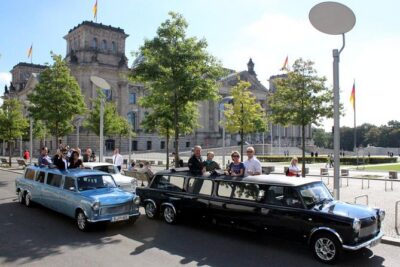
Private Tour: Berlin by Trabant Stretch-Limousine
Read our review →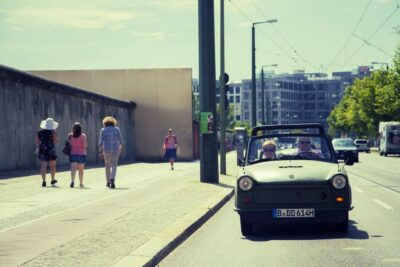

Browse the lists this tour appears in