
Reviewed · RICKSHAW TOURS
Private Guide Up to Group 6 – ONE Rickshaw, (E)Bikes, E-Scooters
This is an interesting way to see Berlin because you mix classic landmarks with a mode of transport that keeps you moving, not stuck waiting. A private guide means you set the rhythm, and you stay together while swapping between vehicles like e-bikes and a rickshaw. It is a good fit if you want history explained in plain language, with frequent stops for photos.
I especially like two things: you get a real storytelling guide, with Levi bringing humor and a personal approach, and you can tailor the experience around your comfort level. The other big win is practical access to the sights, including close photo moments around major monuments. One possible drawback is that the route packs in a lot of Berlin’s biggest names in about 3 hours, so some stops are short and you get snapshots, not deep museum time.
Key things to know before you go
- Private group up to 6 with your guide, so the pace is yours
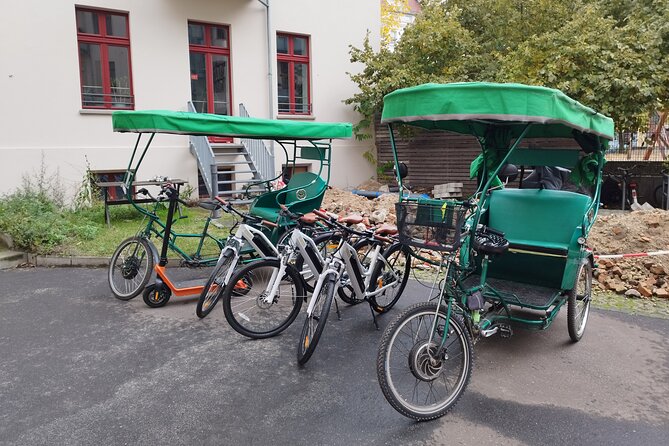
- Vehicle mix: e-bikes, regular bikes, e-scooters, and a rickshaw option
- Built for less mobile guests, with minimal steps to get into the rickshaw
- Stop anywhere for photos, with the option to get very close to monuments
- Levi’s style: funny, personal, and responsive to questions
- Comfort included: bottled water, WiFi on board, and an air-conditioned vehicle
Why this private rickshaw and bike format feels better than a bus
Berlin can be a lot. The city is huge, the distances add up, and major sites are spread out across different neighborhoods. This tour solves that problem by keeping you moving with a small group and using different vehicles so everyone can stay in the same story, at the same time.
You also get a guide who works like a human, not like a script. In the experience I liked best, Levi was direct, funny, and fact-filled, and he handled questions without making you feel rushed. If you like learning bits you can use right away, this format tends to click because you stop often enough to make each explanation land.
There is also a nice “together, but different” design. You can choose from several transport types, yet the group still follows the same route and gets the same information at the stops. That matters if you are traveling with friends or family who do not all want the same kind of ride.
More rickshaw tours in Berlin:
- Berlin: Private Guided E-Rickshaw Tour
★ 4.9 · 157 reviews - Individual City Tour – Rickshaw Sightseeing in Berlin
★ 5.0 · 120 reviews - Berlin Express: Private 1-Hour E-Rickshaw Ride
★ 5.0 · 116 reviews
Price and value: what $465.43 per group actually covers
The price is $465.43 per group (up to 6) for about 3 hours. That is not the cheapest way to tour Berlin, but it can be good value because it is private and includes more than “just talking.”
For your money, you are getting:
- A private guide
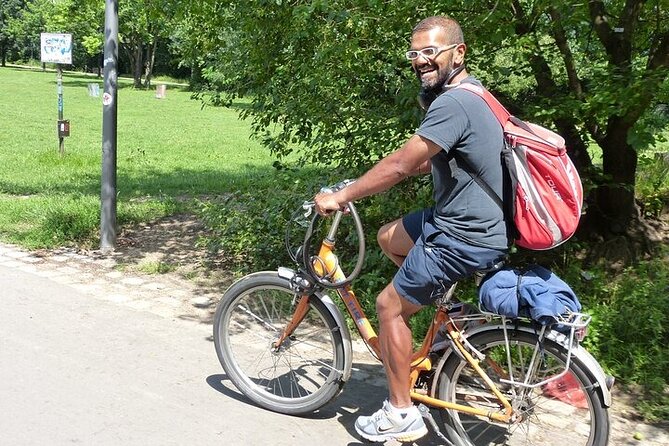
- A vehicle setup that can include e-bikes and a rickshaw
- Air-conditioned vehicle service
- WiFi on board and bottled water
- A mobile ticket
When you do the math, the cost per person drops a lot when you fill the group. If you go as a full party of 6, it comes out around $78 per person for 3 hours, with transport and guide included. If you go with fewer people, the per-person cost rises, so it is best when you have a small cluster of friends or family who are comfortable sharing a group tour.
Choosing your wheels: rickshaw, e-bikes, bikes, and e-scooters
This tour gives you options, which is huge in a city like Berlin. You can ride:
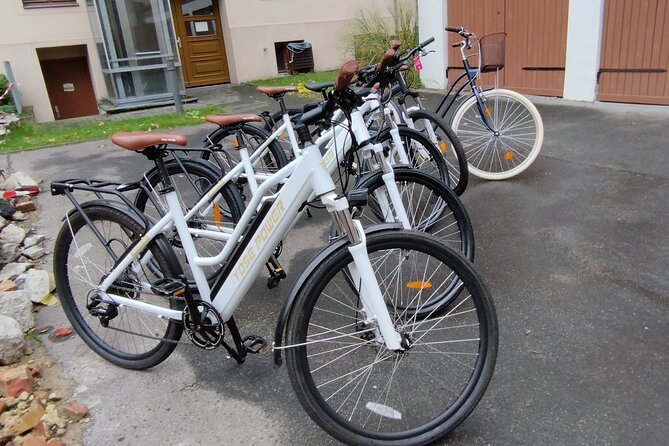
- E-bikes
- Regular bikes
- E-scooters
- A rickshaw (described as especially helpful for guests with trouble getting around)
The best part is not just choice, it is coordination. You stop and learn together, with the guide sharing the same information for everyone at each stop. So even if one person is in the rickshaw and others are on bikes, you are still experiencing the same Berlin story in parallel.
If mobility is a concern, the rickshaw option is the practical angle. The tour notes that in a few steps you enter the rickshaw, and once you are in, you can get close to monuments for photos. You can even stop for pictures without needing to climb, walk far, or worry about keeping up at every moment.
Starting at Fernsehturm: skyline views and an easy first landmark
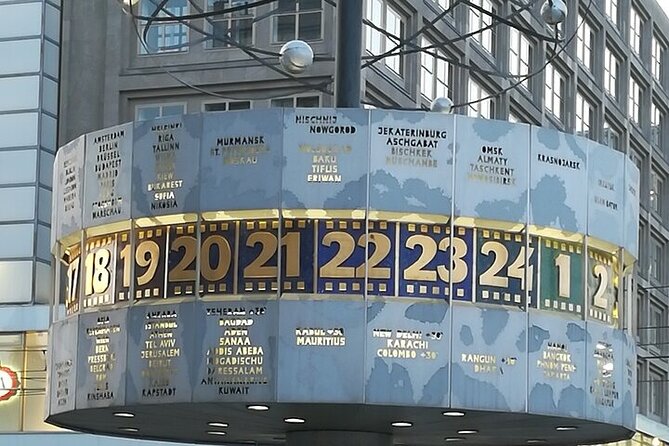
You meet at Weinbergsweg 6, 10119 Berlin, and the route begins at the Berlin TV Tower (Fernsehturm) area, right above Alexanderplatz. Fernsehturm is one of Berlin’s most recognizable shapes: a tall tower with a distinctive spherical top. It is also a functional symbol of modern Berlin.
The guide’s first job is to get you oriented. From this viewpoint you can understand how the neighborhoods connect, and it sets the tone for the day: modern Berlin next to older political and cultural layers.
You also get a built-in advantage here. Fernsehturm is tall and central, so your eyes learn the city quickly. Once you have that mental map, the rest of the stops make more sense, because you can start noticing alignments, boulevards, and how the city repeats certain themes of power and recovery.
More scooter rentals in Berlin:
- Berlin: Thrilling E-Scooter Adventure Tour
★ 4.4 · 66 reviews - 2-H Berlin: Top Sights Guided E-Scooter Tour
★ 4.3 · 48 reviews - Berlin: Ultimate E-Scooter Adventure Tour
★ 4.5 · 35 reviews - Berlin: 3-H Top Sights Guided E-Scooter Tour
★ 4.6 · 33 reviews
Berlin’s political core, Rotes Rathaus area
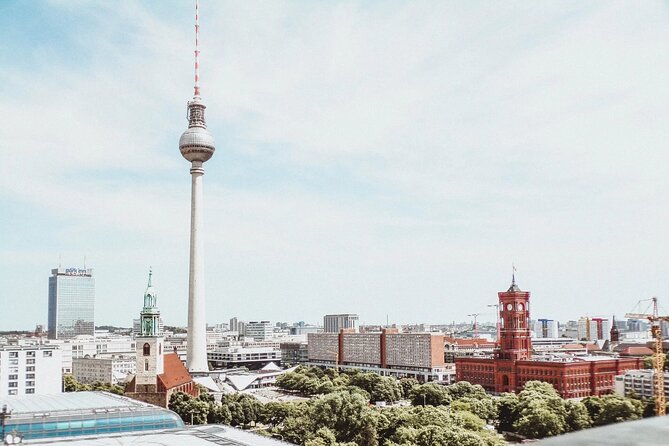
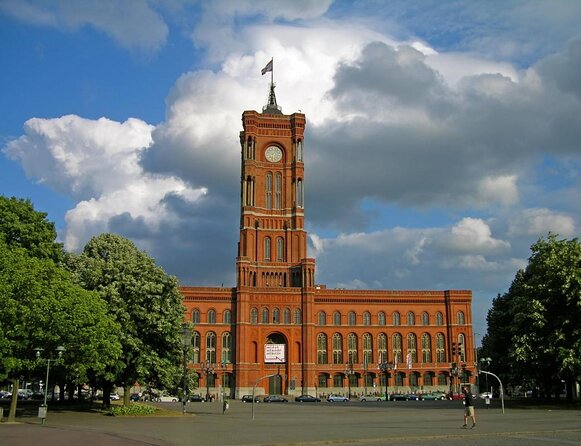
Next you pass through the mood of Berlin government. The Rotes Rathaus (City Hall) is described as a central hub for political activity and administration, and it is a cornerstone of the city’s identity.
This stop is less about a single must-see photo and more about context. You start to see how Berlin’s public spaces are designed to signal order and authority. It also helps you connect later stops about division and reunification with the everyday reality of how the city runs today.
If you like your history with a “why it matters” explanation, this is where it starts. The guide uses the location to point out what the building represents and why it is positioned where it is.
Stadtschloss Berlin and Museum Island: palace debates and culture anchors
Then you move into the center of Berlin’s story, where rebuilding and preservation show up in big ways.
Stadtschloss Berlin (Berlin City Palace)
Stadtschloss Berlin (Berlin City Palace) is tied to centuries of royal life, war damage, and post-war debate. It was constructed in the 15th century, destroyed during WWII, and after the Berlin Wall fell there was a serious discussion about whether to reconstruct it.
The outcome today is the Humboldt Forum project, restoring a Baroque façade while using modern interiors for cultural purposes. It is one of those places where Berlin’s history is not just remembered, it is actively argued, rebuilt, and repurposed.
You get a short stop here, about 15 minutes, and that is enough for the big story: what it meant, what happened, and why Berlin chose the path it did.
Museum Island
From there you go to Museum Island, a UNESCO World Heritage site and a cluster of museums and artifacts. This is more than a label. The idea here is that Berlin is intentionally preserving its cultural heritage and sharing it with the world.
The stop is about 20 minutes. You will not have time to do a full museum visit in that window, but the purpose is different. The guide helps you understand the area’s role and why it matters for Berlin’s identity.
Unter den Linden: a boulevard that strings monuments together
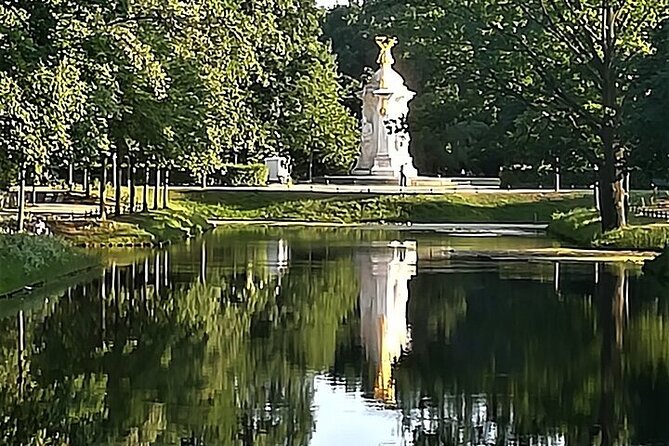
You then head to Unter den Linden, the famous boulevard with a mix of architectural styles. Think Baroque, Neoclassical, and modernist touches in one long public corridor.
The guide points out major landmarks you might recognize:
- Brandenburg Gate
- Berlin State Library
- Kronprinzenpalais (Crown Prince’s Palace)
This is a smart stop because it teaches you how Berlin narrates itself through streets. When you walk or ride along a boulevard like this, you start to see why certain buildings feel connected. It helps the later Cold War sites hit harder too, because the city layout tells a story about power before and after division.
The stop time is about 10 minutes, so treat it as a “move and notice” segment.
Bebelplatz and its memorial for book burning
One stop carries a heavier emotional tone: Bebelplatz. Historically it was known as Opernplatz and it is linked to the Nazi regime’s book burnings in May 1933.
Today, there is a memorial designed by Micha Ullman. The key detail is simple and chilling: a glass plate on the ground reveals empty bookshelves underneath. The point is not decoration. It is a reminder of how censorship works and why intellectual freedom matters.
The stop here is about 10 minutes. Even in a short time, it is memorable, because it is built to slow you down at street level. If you are the kind of person who likes learning but also feels things, you will likely want to stand still for a moment and read the message before moving on.
Gendarmenmarkt: the church trio and Berlin’s cultural postcard
After the weight of Bebelplatz, you get a beautiful contrast at Gendarmenmarkt. This square is famous for its neoclassical architecture and for three iconic buildings.
The guide highlights:
- Konzerthaus, a concert hall with world-class performances
- French Cathedral, built by Huguenot refugees in the 18th century, symbolizing tolerance and diversity
- German Cathedral, with an elegant façade and museum inside
The stop is about 10 minutes, and this is one of the places where you can score a great photo quickly. The geometry of the square helps, because the buildings frame you in a way that looks good from multiple angles.
If you want at least one segment of the day where Berlin feels elegant and light, this is it.
Checkpoint Charlie: Cold War reality with a stage set
Next comes Checkpoint Charlie, one of the most iconic symbols of Cold War division and reunification. The name is explained as coming from the third letter in the NATO phonetic alphabet, and the place is tied to American and Soviet sectors.
Today, there is a replica guardhouse, with actors dressed as U.S. military police. It is described as a way to glimpse that tense historical period. There is also a museum now known as the Mauermuseum.
The stop here is about 15 minutes. This is long enough to understand the story and take a few pictures, but short enough that you can avoid turning it into a full museum day when your tour is only about 3 hours.
If you prefer historical sites that focus more on the facts than the theatrics, you may feel this one is a bit more performative. But the guide’s job is to connect the street-level scene to what it meant in real life.
Topography of Terror: Nazi headquarters, shown through documents and remnants
Then you go to Topography of Terror, once the Nazi Gestapo and SS headquarters. This museum is designed to recount Nazi atrocities with exhibits, documents, and remnants of the original buildings.
The emphasis here is heavy and clear: learning about the Holocaust and the importance of resisting intolerance. The stop is about 20 minutes, and that is usually enough time for the guide to point out the key ideas and help you make sense of what you are seeing.
This stop may be emotionally intense for some people. If you are traveling with kids or anyone sensitive to difficult topics, you will want to check in with the group’s mood here. The upside is that the guide frames the setting, so it does not feel random.
Führerbunker: the story of the underground last months
You also pass through the area connected with the Führerbunker, Adolf Hitler’s underground bunker complex near the Reich Chancellery. The site details are stark: it was built under the garden and today the bunker’s location is under a parking lot. There is no visible trace.
After the war, it was primarily removed to prevent it from becoming a pilgrimage site for neo-Nazis. The lesson is about memory and responsibility, not spectacle.
The stop here is short, around 10 minutes, so focus on the guide’s context. You are not visiting a preserved structure. You are learning what existed and why its remnants are not part of the city’s visible landscape.
Holocaust Memorial: when the city drops away under your feet
You then reach the Memorial to the Murdered Jews of Europe, designed by Peter Eisenman and inaugurated in 2005. This memorial is composed of 2,711 concrete slabs that vary in height and form a maze-like field.
The design creates disorientation. As you move inward, the ground slopes downward and the space feels separated from the city noise. The guide’s explanation centers on anonymity and the scale of the victims.
The stop time is about 10 minutes, and that is enough to feel the emotional design. I recommend taking this part slowly. Even if you want photos, pause for a moment without looking at your screen, just to notice how the space changes you.
Brandenburg Gate: the headline monument and its long memory
You finish with Brandenburg Gate, Berlin’s most iconic landmark. The tour describes it as a neoclassical triumphal arch completed in 1791 under Carl Gotthard Langhans. It has witnessed more than two centuries of events tied to peace, power, and reunification.
The guide connects it back to Unter den Linden, since the boulevard begins from here. In a tour like this, ending at Brandenburg Gate works well because it gives you a clear visual anchor and a place where the city’s themes feel concentrated.
The stop here is about 10 minutes. It is short, but by now, you have enough context to see how that arch can represent totally different eras depending on what you understand.
What I’d consider before booking
This tour is designed to be comfortable and flexible. Still, there are a couple of things to think about.
First, the route includes major Holocaust and Nazi related sites. If you are traveling with someone who gets overwhelmed by difficult topics, plan your expectations. The guide will provide context, but the sites are meant to be hard.
Second, with about 3 hours and roughly 10 to 20 minutes per stop, you are getting highlights. It is not the day to expect long museum sessions at each location.
Third, your transport choice matters. If you pick bikes, you should feel comfortable riding in an urban setting. If you want the easiest ride, the rickshaw option is built for less mobile guests and for getting very close for photos without long walking.
Who this tour suits best
This is a strong match if:
- You want a private Berlin experience with a guide and a small group
- You like mixing transport with storytelling, not just walking
- You have different mobility needs in the same group
- You want frequent photo stops and a guide who will help you time them
- You appreciate a humorous, personal guide style, like Levi’s
It is also a good family option. One account described Levi involving children in the day and keeping the stories engaging. That does not mean every hard stop will be kid-friendly, but it suggests the guide is good at reading the group and adapting his delivery.
Should you book it?
If your goal is to see major Berlin highlights in about 3 hours with a private guide, this is easy to recommend. The value is strongest when your group is close to the maximum size, because you get transport, water, WiFi, and an air-conditioned ride plus a story-driven route.
Book it if you want a practical, moving tour that keeps everyone together, including those who may need a rickshaw. Skip it if you prefer long museum time, or if your group would rather avoid emotionally heavy historical stops. In that case, you may want a lighter, shorter route.
For most people doing Berlin for the first time or for people who want a “best of” day without car logistics, this format is one of the smarter choices.
FAQ
How long is the tour?
It runs for about 3 hours.
Is this a private tour?
Yes. It is a private tour/activity, and only your group participates.
How many people can join?
The tour is priced for a group up to 6.
What vehicle options are available?
You can choose from e-bikes, regular bikes, e-scooters, or a rickshaw.
Where does the tour start and end?
The meeting point is Weinbergsweg 6, 10119 Berlin, Germany, and the activity ends back at the meeting point.
What’s included in the price?
The tour includes the guided experience and vehicle use (including bike and rickshaw options), air-conditioned vehicle, WiFi on board, bottled water, and an informative friendly guide. You also get a mobile ticket.
Is lunch included?
No, lunch is not included.
Is the tour suitable for less mobile guests?
It is described as ideal for less mobile guests. You enter the rickshaw in a few steps, and the tour can stop anywhere for pictures so you can get close to monuments.
What is the cancellation policy?
Cancellation is free up to 24 hours in advance of the experience’s start time for a full refund.
Is it confirmed at booking time?
Confirmation is received at the time of booking.
Recently added around Berlin
- Berlin Private Custom Walking Tour With A Guide (Private Tour)★ 4.5 · 8 reviews
- One Up to 3 Rickshaws(6 GUESTS)-Taylor Made Rickshaw Berlin Tour★ 5.0 · 20 reviews
- Moonshine Comedy – English Stand Up Comedy by the bay★ 5.0 · 11 reviews
- Private Half-Day Berlin Sightseeing Tour with a Minivan Including Short City Walks★ 5.0 · 31 reviews
- Private taxi tour to Potsdam and Sanssouci 6-8h★ 5.0 · 30 reviews
- Private City Kickstart Tour: Berlin★ 4.5 · 71 reviews
- Private tour of Berlin★ 5.0 · 15 reviews
- Private Tutankhamun’s Tomb Live Escape Room in Berlin★ 3.5 · 11 reviews
Rickshaw Tours, compared.
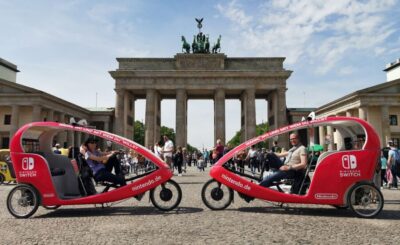
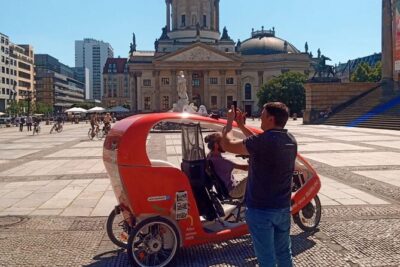
Individual City Tour – Rickshaw Sightseeing in Berlin
Read our review →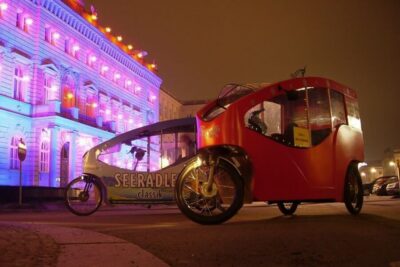
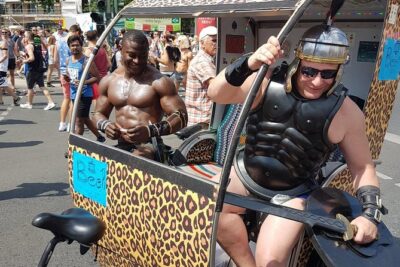
Rickshaw Tours Berlin – Groups of up to 16 people with several rickshaws
Read our review →
Rickshaw Sightseeing City Tours Berlin – Rikscha Tours
Read our review →
One Up to 3 Rickshaws(6 GUESTS)-Taylor Made Rickshaw Berlin Tour
Read our review →
Berlin Rickshaw Tours Historical & Photo City Tour 120min – Sightseeing
Read our review →Browse the lists this tour appears in