
Reviewed · HISTORICAL TOURS
Karl-Marx-Allee Walking Tour: Berlin’s Socialist History
Karl-Marx-Allee is interesting because it looks like stone confidence, yet every block has a second, darker layer. I love the way the tour connects socialist architecture to what East Berliners actually lived through, from postwar rebuilding to crackdowns. I also like that you end up thinking about ideology as something physical, not just political slogans.
One possible drawback to consider is that this is a heavier history walk, and it is not suitable for children under 10, so keep expectations age-appropriate.
Key moments you will not forget
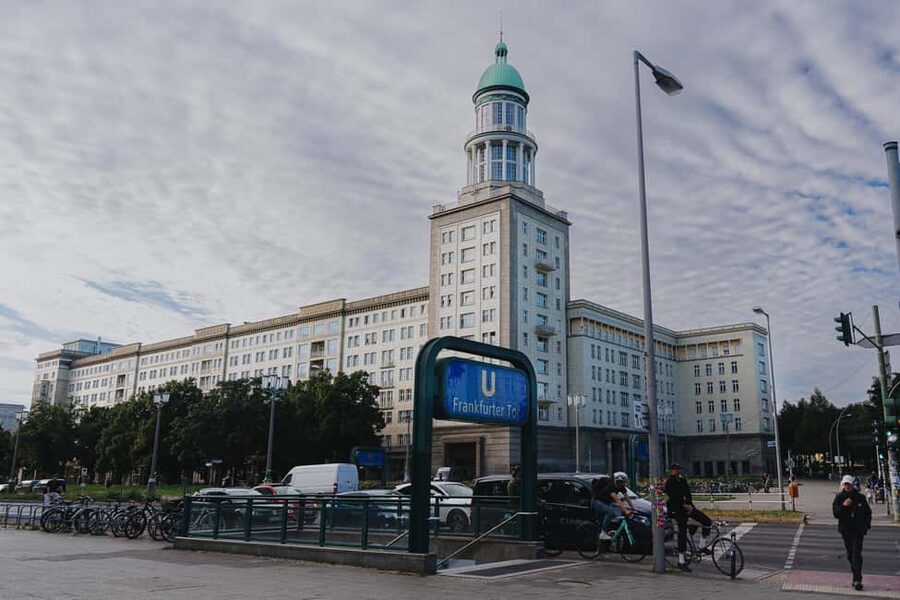
- Socialist classicism up close, built to project power after World War II
- The most ambitious former East Berlin building project, and how it shaped daily life
- The June 1953 uprising, explained as part of the street’s story, not just a date
- Stasi surveillance hidden in plain sight, including wiretaps and listening setups
- Film locations, including The Lives of Others and The Queen’s Gambit
How Karl-Marx-Allee turns ideology into architecture
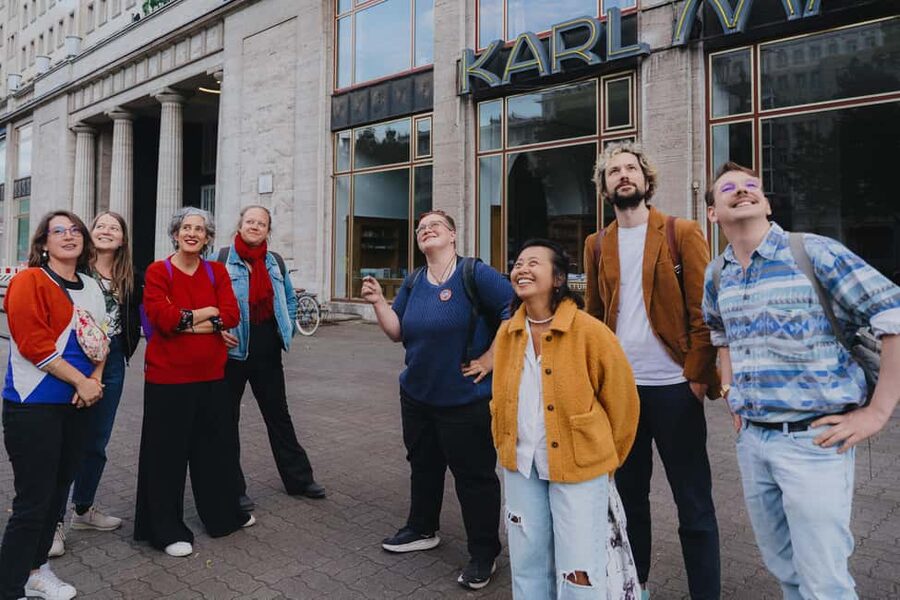
If you only look at the buildings, Karl-Marx-Allee can feel strangely impressive. The housing blocks are grand, symmetrical, and built to make you stand a little straighter as you walk past. But the point of this tour is to show you that the street was never just about housing.
You will learn how the Cold War shaped Berlin’s architecture, and how East German leaders tried to sell a particular idea of socialism through form, scale, and public space. That is why the street often gets described as Germany’s first socialist street. The buildings were meant to be proof, like a living brochure for a system still trying to earn legitimacy.
The other reason this tour hits is that it connects big ideas to real pressure. You will hear about the struggles of East Berliners, and you will also confront how suppression was built into the everyday, including the Stasi’s habits of listening and controlling.
More history tours in Berlin:
- Berlin: Natural History Museum Entrance Ticket
★ 4.6 · 3,382 reviews - Berlin: World Heritage Cruise to Potsdam
★ 4.5 · 1,435 reviews - Berlin Historical Highlights Walking Tour
★ 4.9 · 657 reviews
Starting at U Frankfurter Tor, and getting your bearings fast
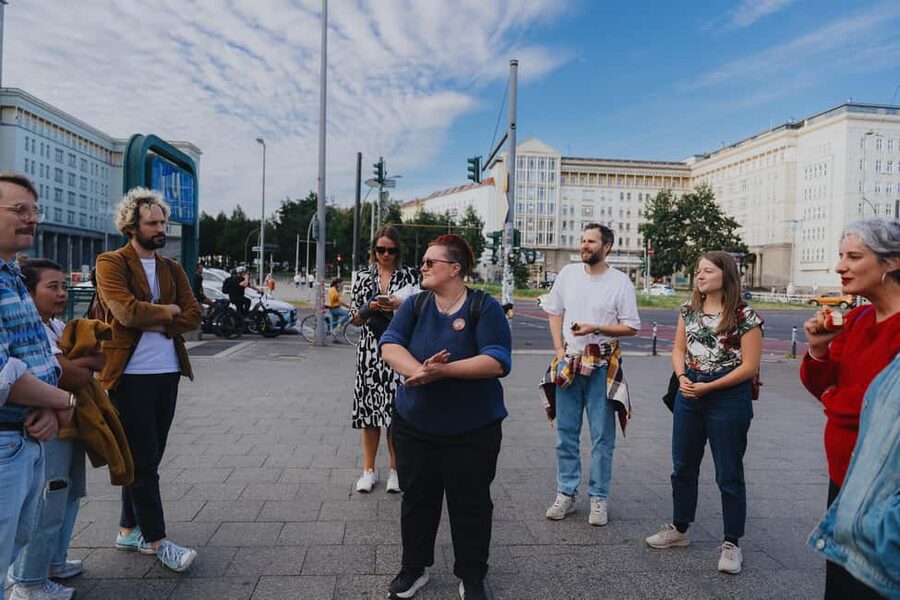
The walk begins outside U Frankfurter Tor, at the corner of Warschauer Straße and Karl-Marx-Allee. Your guide will be easy to spot, holding an orange umbrella, which is a small detail that saves you from milling around in the wrong place.
I like starting here because it sets the tone. You are not just stepping into a random “old street.” You are entering a corridor shaped by postwar planning and Cold War messaging, and the guide frames what you are about to see right away.
If you have questions, this is also a good sign for how the tour runs. One guide name that pops up in real experience is Martina, and the vibe is attentive and responsive, not a rigid lecture that bulldozes through anything you find curious.
Karl-Marx-Allee, the bold main line of East German rebuilding
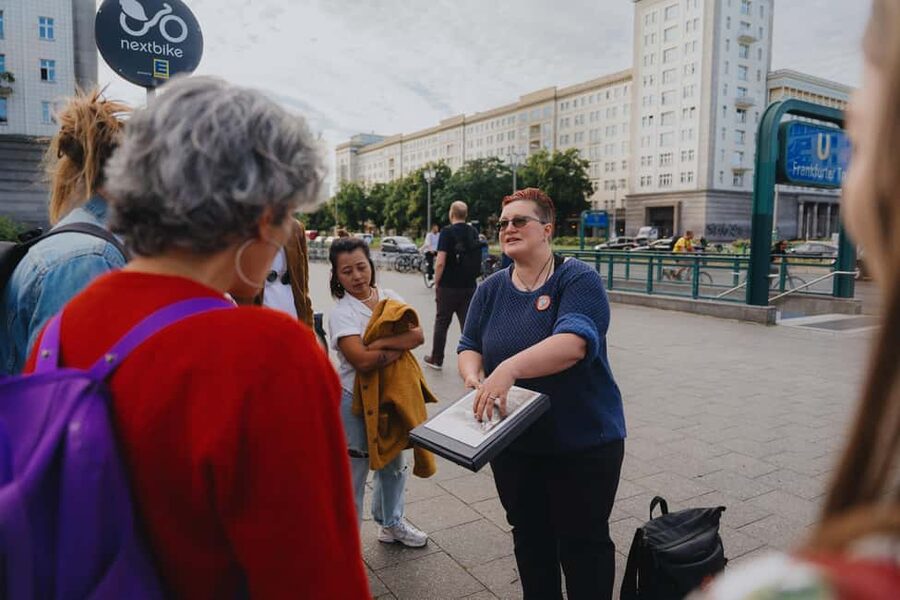
Most of your time goes into the street itself. You will walk through Karl-Marx-Allee and get a guided explanation of why these buildings look the way they do, and why that style mattered to the new state after the war.
A key idea is that the street emerged from ruins with serious manpower. Thousands of volunteers worked day and night as the area became the main project of the East German national reconstruction programme. When you hear that, the architecture changes in your mind. It stops being only “pretty official buildings,” and starts looking like effort, urgency, and political will turned into concrete.
You will also learn that the street’s story stretches further back than the big 1950s blocks suggest. In the immediate postwar years, the area had modernist influences and utopian urban planning ideas, born out of destroyed Berlin. Later on, the East German regime had a different vision of what socialist living should look like, and they moved away from those earlier ideas.
Even the landscaping gets a mention. Fast-growing poplar trees were used to hide buildings from passersby. That detail is fascinating because it shows how the regime controlled what people would notice, not just what they would say.
Admire the ambition, then face what it cost

The tour does something smart: it lets you feel the scale first, then brings you back down to the stakes. Karl-Marx-Allee was not a casual construction project. It was the kind of mega-build that signals a state trying to prove it can deliver.
But the building of the street almost cost the young East Germany its existence. In June 1953, disgruntled workers started a mass uprising that nearly toppled the socialist government. Walking the corridor with that context in mind changes your interpretation of everything.
You start to see the tension between appearances and control. The street wanted to look stable and prosperous, but it was built in a period where the system’s legitimacy was fragile. The guide’s job is to keep that balance clear: impressive architecture, but also a society under strain.
More walking tours in Berlin:
- Discover Berlin Half-Day Walking Tour
★ 5.0 · 9,624 reviews - Berlin: Third Reich and Cold War 2 Hour Walking Tour
★ 4.9 · 6,830 reviews - Berlin: Discover Berlin Walking Tour
★ 4.9 · 5,998 reviews - Berlin’s Best: 2 Hour Walking Tour Third Reich and the Cold War
★ 5.0 · 5,486 reviews
The 1953 uprising: more than a history headline

The June 1953 uprising is easy to file under Cold War trivia. This tour helps you understand it as part of the street’s internal contradiction: the ambition to project confidence while the population struggled with dissatisfaction.
You will hear how workers’ discontent escalated quickly. The point is not just that unrest happened. It is that unrest happened at the same time a monumental public project was meant to represent the state’s future.
That is one of the reasons this walk works well for people who like history with cause and effect. You are not learning dates in a vacuum. You are connecting the built environment to political pressure, and you are watching how leadership choices can collide with everyday reality.
Stasi surveillance and the perfect facade
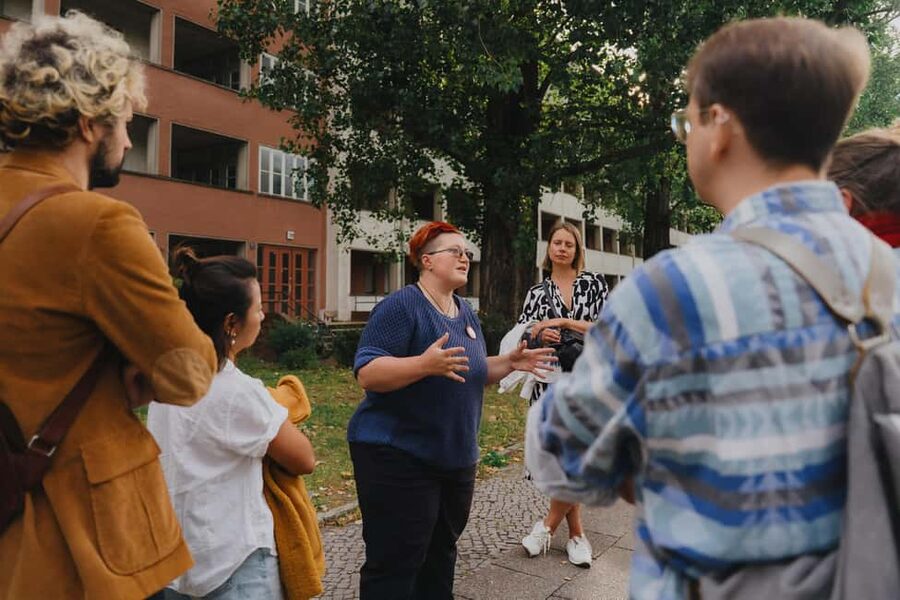
One of the most striking themes is how surveillance was hidden while the street sold a normal, even comfortable, life. The street had the essentials that make an area feel complete: cafes, restaurants, and well-stocked shops. The goal was a picture of idyllic daily living in socialism.
But behind that facade, the reality of control stayed active and well hidden. You will learn about wiretaps in flats and listening stations in attics used by the secret police. You will also hear how the system was designed so people could not easily see the machinery watching them.
This is where the tour earns its weight. It does not just say Stasi existed, it helps you grasp how surveillance could blend into ordinary spaces. When you picture listening setups in home attics, you start to understand why trust was complicated in a place that looked livable on the surface.
Film locations: how The Lives of Others and The Queen’s Gambit use the street

Berlin loves reusing real locations, and Karl-Marx-Allee has been part of that. You will see filming locations connected to The Lives of Others and The Queen’s Gambit.
This matters even if you are not a film fanatic. Seeing a familiar cinematic backdrop in daylight helps you notice details you might have missed otherwise: the sense of order, the monumental feel, and the way the street can look both staged and real at the same time.
It is a useful trick. Film frames a mood. A walking tour gives you the context that makes the mood make sense.
After the Wall: neglect, then redevelopment and protests
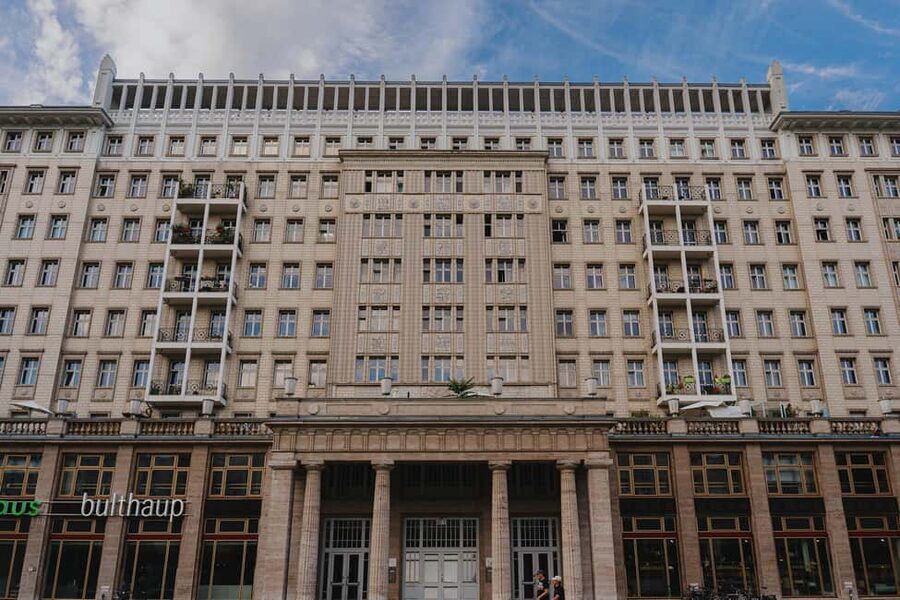
The story does not end with political change. After the fall of the Wall, the street ended up in a strange middle zone. In a state of disrepair and increasingly looking like an odd curiosity from the past, it seemed to fade from the spotlight.
But Berlin rarely leaves neighborhoods alone for long. As the city faced a housing crisis, real estate attention returned. The street shifted again from being a boulevard for socialist parades to something much more contemporary, including protest routes.
You will learn about community pushback against gentrification and rising living costs. That adds a sharp closing layer: ideology may change, but pressure on residents keeps returning in new forms. It is not the same story, but it helps you see how public space affects power and money, year after year.
Price and timing: is 2 hours worth it for $23?
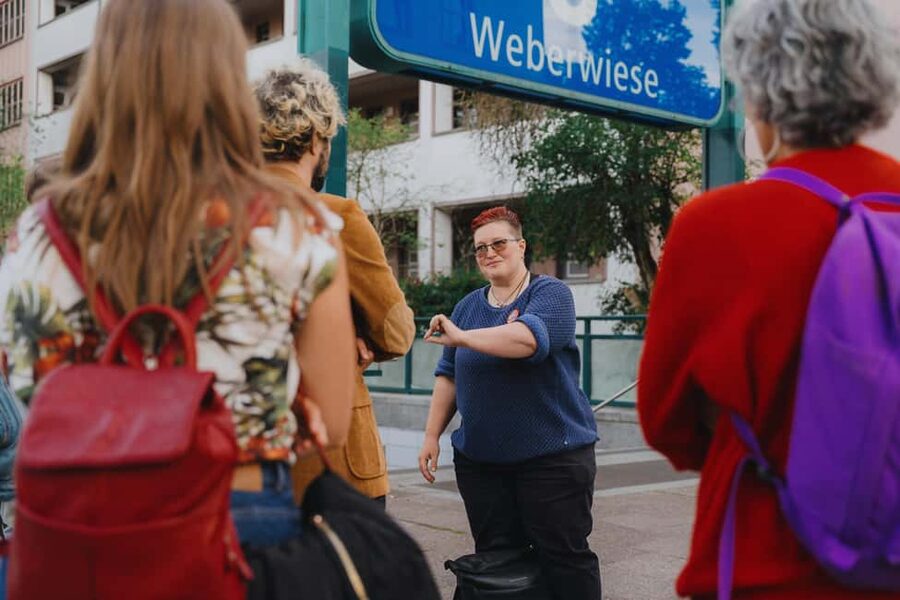
At $23 per person for about 2 hours, this feels like good value for a guided experience that covers architecture, political history, and surveillance realities, plus film locations. You are not just looking at buildings from the outside. You are getting interpretation, names, and connections that would be hard to assemble on your own in a quick walking window.
Plan on comfortable shoes. You are walking a meaningful stretch, and the topic is dense enough that you will want to stay focused, not distracted by sore feet.
The tour runs in English and German, so it is accessible even if you are not comfortable navigating Berlin history in German. It is also wheelchair accessible, which is a practical plus if you need step-free routing.
One more note: children under 10 are not suitable, so if you are traveling with younger kids, you may want to look for a different option.
Ending near U Strausberger Platz, with context still in your head
The walk finishes at U Strausberger Platz. That end point helps you keep moving rather than feeling trapped at a single spot. Also, the activity is listed as ending back at the meeting point, so you might see some variation in how the organizer describes the final location versus the actual drop-off.
Either way, your mental map will be solid by the end. You will have gone from the street’s official purpose, to the 1953 uprising pressure, to the Stasi’s hidden surveillance, and then on to what happened after the Wall.
Who should book this walk?
This one fits especially well if you like:
- Architecture with politics attached
- Cold War history that connects directly to how people felt
- Stories about control, surveillance, and how regimes shaped daily life
- Film-in-place experiences tied to real locations
It may be less ideal if you want a light, scenic stroll. This is a walking tour where you learn uncomfortable things, and you should go ready to think.
If you prefer a guide who stays attentive and does not ignore your questions, you are in the right place. The experience style around Martina is described as caring and alert to what people are curious about.
Should you book the Karl-Marx-Allee Socialist History tour?
Yes, I think you should book it if you want one of Berlin’s most visually “statement-making” streets explained with honesty. For $23 and about 2 hours, you get more than sightseeing. You get a guided interpretation that links rebuilding, ideology, uprising, surveillance, film locations, and post-Wall change, all in a walk that is structured but not too long.
Skip it only if you are after pure sightseeing or you need a child-friendly route for kids under 10. Otherwise, this is a smart use of time, and Karl-Marx-Allee deserves to be seen with context, not just admiration.
FAQ
How long is the Karl-Marx-Allee Walking Tour?
It is listed as a 2-hour tour. Check availability to see starting times.
How much does the tour cost?
The price is $23 per person.
Where do I meet the guide?
Meet outside U Frankfurter Tor station, on the corner of Warschauer Straße and Karl-Marx-Allee. The guide will be holding an orange umbrella.
Where does the tour end?
The itinerary says it finishes at U Strausberger Platz. The activity info also notes it ends back at the meeting point, so you should plan for a return near where you started.
What languages are available?
The tour is offered in English and German.
Is the tour wheelchair accessible?
Yes, it is listed as wheelchair accessible.
What should I wear or bring?
Bring comfortable shoes for walking.
FAQ
Is this tour suitable for kids?
It is not suitable for children under 10.
What is the cancellation policy?
Free cancellation is available up to 24 hours in advance for a full refund.
Can I book without paying immediately?
Yes. The listing offers reserve now and pay later, so you can book your spot and pay nothing today.
Recently added around Berlin
- Berlin Private Custom Walking Tour With A Guide (Private Tour)★ 4.5 · 8 reviews
- One Up to 3 Rickshaws(6 GUESTS)-Taylor Made Rickshaw Berlin Tour★ 5.0 · 20 reviews
- Moonshine Comedy – English Stand Up Comedy by the bay★ 5.0 · 11 reviews
- Private Half-Day Berlin Sightseeing Tour with a Minivan Including Short City Walks★ 5.0 · 31 reviews
- Private taxi tour to Potsdam and Sanssouci 6-8h★ 5.0 · 30 reviews
- Private City Kickstart Tour: Berlin★ 4.5 · 71 reviews
- Private tour of Berlin★ 5.0 · 15 reviews
- Private Tutankhamun’s Tomb Live Escape Room in Berlin★ 3.5 · 11 reviews
Historical Tours, compared.
Berlin Private Complete History All Day Walking Tour
Read our review →


Small group Potsdam: A Journey Through History and Palaces
Read our review →Browse the lists this tour appears in